
How to Sue Your Landlord for a
Security Deposit in
New York Small Claims Court
When your landlord ignores your demand letter or fails to return your deposit within New York’s strict 14-day deadline, Small Claims Court is your most powerful tool. The system is designed for you to represent yourself, and New York law includes powerful penalties—including punitive damages—for landlords who willfully break the rules.
This guide will show you how to file a case in the New York Small Claims Court system. We’ll cover the claim limits, the forms you need, and the evidence you must gather to prove your case and recover your funds.
$39 New York Demand Letter
Mailed in Minutes!
Understanding Your Legal Basis for Suing in New York
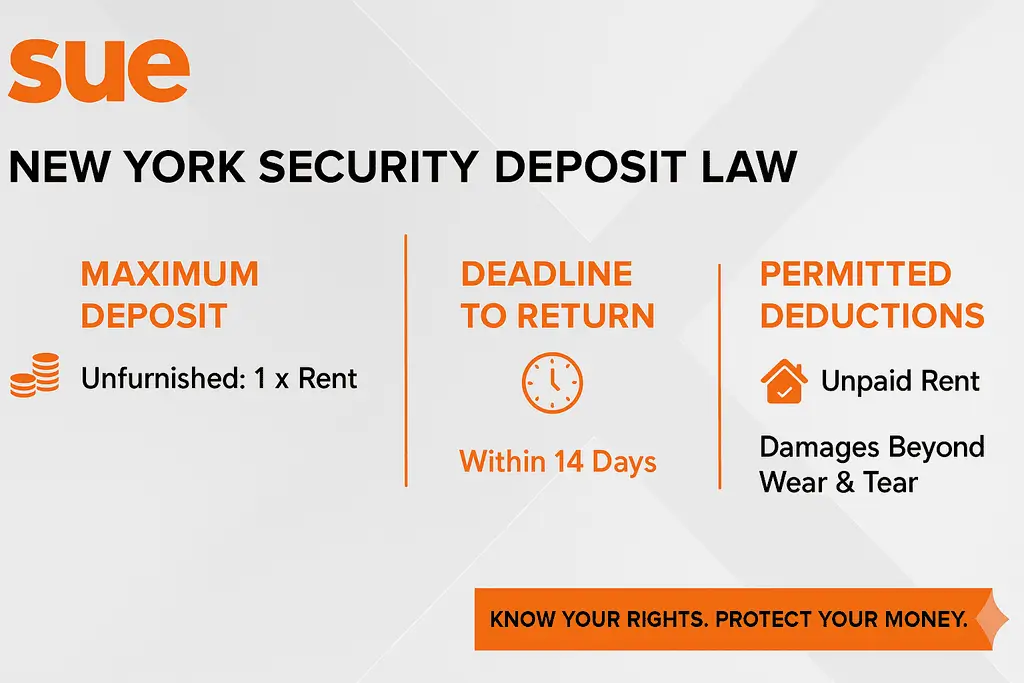
Your lawsuit is built on a clear violation of New York General Obligations Law § 7-108. This is the law that gives your lawsuit its power. As our New York Security Deposit Demand Letter Guide explained, your landlord has only 14 calendar days after you move out to return your full deposit or provide a detailed, itemized statement of deductions.
If your landlord missed the 14-day deadline, they forfeit any right to keep any portion of your deposit. This is a critical point. Furthermore, if you can show the judge that the landlord’s violation was “willful,” the court can order them to pay you punitive damages of up to twice the amount of the deposit, in addition to getting your original deposit back.
This Guide Covers:
-
The $10,000 limit for New York Small Claims Court
-
A step-by-step guide to filling out the “Statement of Claim”
-
How to properly “serve” the notice of the lawsuit
-
The evidence you need to prove a “willful” violation
-
How Sue.com can help you prepare your court forms
Key Questions Before You File Your Case
How Much Can I Sue For?
In New York, the limit for Small Claims Court is $10,000 (in NYC, City, and District Courts). This is high enough to cover your deposit plus the 2x punitive damages (e.g., $2,500 deposit + $5,000 penalty = $7,500 total claim).
Where Do I File My Case?
You must file in the correct court. This is usually the county where the landlord lives, works, or has a place of business.In New York City, you file in the Civil Court for the borough (county) where the landlord is. Outside NYC, you’ll file in the City, District, or Town Court that has jurisdiction.
How Long Do I Have to File? (Statute of Limitations)
The time limit for a breach of a written lease (which is a contract) in New York is six years. You have plenty of time, but it is always best to file your case as soon as possible while the evidence and events are still fresh.
How to File Your Small Claims Case in New York: A Step-by-Step Guide
Step 1: Get the Correct Form
The main form to start your case is called a “Statement of Claim.” In New York City, this is Form CIV-SC-50. You can get this form from the Small Claims Clerk’s office, or often download it from the court’s website.
Step 2: File Your Claim with the Court Clerk
You must file the completed form with the Small Claims Court Clerk in the proper county. You will need the landlord’s full legal name and correct address. You will state on the form why you are owed money (e.g., “Landlord failed to return $2,500 security deposit within 14 days, in violation of GOL § 7-108”).
Step 3: Pay the Filing Fees
You will have to pay a very small filing fee. In NYC, for example, it’s only $15 for claims up to $1,000 and $20 for claims over $1,000. These fees are low to ensure everyone has access to the court. If you win, the judge will add these fees to the amount the landlord has to pay you.
Step 4: "Serve" the Claim on Your Landlord
In New York, this part is often easier than in other states. The Court Clerk will usually handle the service for you by mailing the summons to the landlord via certified mail and first-class mail. In some cases, or if the mail fails, you may need to hire a professional process server or have a friend or relative over 18 (who is not part of the case) serve the papers.
Gathering Your Evidence to Win
You must be prepared to prove your case to the judge. To win punitive damages, you need to show the landlord’s violation was “willful.”
-
The Lease: Your original signed lease agreement.
-
Proof of Payment: Canceled checks or bank statements proving you paid the security deposit.
-
The 14-Day Violation: This is your strongest evidence. Show the date you moved out (e.g., a move-out email) and the date on the postmark of the landlord’s late response, or show that no response ever came.
-
The Demand Letter: A copy of the formal demand letter you sent and its certified mail receipt.
-
Move-In/Move-Out Photos: Photos or videos showing the clean condition of the unit, which counters any claims of “damage” the landlord might make in court.
-
All Communications: Any emails, texts, or letters where the landlord was dismissive or ignored your requests.
How Sue.com Helps You File Your Case
The New York court system has specific forms and rules. Our $99 Small Claims Court Package is designed to give you the confidence to navigate it.
The $39 Demand Letter was the first step. This is the next. We move beyond just a guide and help you:
-
Prepare Your Official “Statement of Claim”: We help you fill out the correct forms, making sure you clearly state your case for both the deposit and the 2x punitive damages under § 7-108.
-
Organize Your Evidence: We’ll help you structure your evidence file to build a clear, simple, and powerful case for the judge, focusing on the 14-day rule violation.
-
Guide You on Next Steps: We provide guidance on what to expect at your hearing and how to follow up.
This package is designed to demystify the process and help you take the final step to recover your money.
Resources
-
New York State Unified Court System (Small Claims): https://www.nycourts.gov/courthelp/SmallClaims/index.shtml
-
New York General Obligations Law § 7-108: https://www.nysenate.gov/legislation/laws/GBS/7-108
-
New York Attorney General (Security Deposits): https://ag.ny.gov/resources/residential-tenants/security-deposits
Step 1
Answer a Few Simple Questions
Tell us what happened — who owes you, how much, and why. Our system guides you step-by-step with no legal jargon.
Step 2
We Draft Your New York Demand Letter
Using your answers, we instantly generate a professionally written, legally sound New York demand letter tailored to your situation.
Step 3
We Mail It for You
We print and mail the New York demand letter directly to the recipient via USPS — creating proof you attempted to resolve the matter before court.

Ready to Send Your New York Demand Letter?
Need Assistance?
Need help?
Find answers
Got questions about how Sue.com works, what’s included in each package, or what happens after your letter is sent? We’ve got you covered — quick, clear answers to help you move forward with confidence.
What is the maximum amount I can sue for in New York Small Claims Court?
In most New York courts, including New York City, the maximum claim is $10,000. In some Town and Village Courts, the limit may be lower (e.g., $3,000 or $5,000), so always check with your local court clerk.
Are lawyers allowed in New York Small Claims Court?
Yes, lawyers are permitted in New York Small Claims Court. However, the system is specifically designed for you to represent yourself (“pro se”), and most people do.
What happens if my landlord doesn't show up to court?
If you have proof that your landlord was properly served with the court notice and they fail to appear, the judge will hear your side of the case. You can then ask for a “default judgment,” and the judge will likely rule in your favor and award you the money.
My landlord did send an itemized list, but I disagree with the charges. Can I still sue?
Yes. In this case, your lawsuit is not about the 14-day rule, but about the reasonableness of the deductions. You will use your move-out photos and other evidence to show the judge that the landlord’s claims of “damage” were actually just “normal wear and tear.”
How do I prove my landlord's violation was "willful" to get punitive damages?
“Willful” means the landlord knew about the rule and intentionally disregarded it. The best evidence is showing they completely ignored the 14-day deadline, refused to respond to your demand letter, or sent a list of clearly fraudulent charges. A judge has the final discretion to award these damages.