
How to Sue Your Landlord for a
Security Deposit in
Illinois Small Claims Court
If you’ve already sent a demand letter for your security deposit and your landlord has ignored it, your next and most powerful step is Small Claims Court. Illinois provides a simplified legal process for disputes under $10,000, allowing you to sue your landlord and recover your money without hiring an expensive lawyer.
This guide will walk you through the entire process, from finding the right forms to what to do on your court date. You have rights under the Illinois Security Deposit Return Act, and Small Claims Court is where you can enforce them.
$39 Illinois Demand Letter
Mailed in Minutes!
Understanding Your Legal Basis for Suing in Illinois
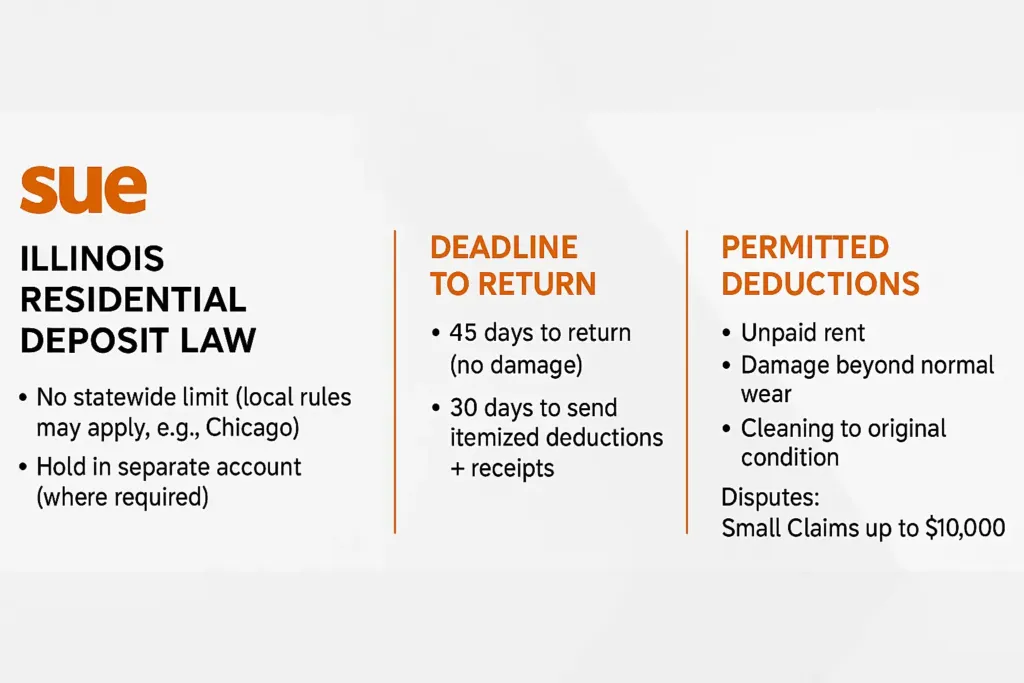
Your right to sue comes directly from the Illinois Security Deposit Return Act (765 ILCS 710/1). This is the law that gives you your power. As our Security Deposit Demand Letter Guide explains, your landlord is in violation if they failed to return your deposit within 45 days, or failed to provide an itemized list of deductions within 30 days.
The Illinois Small Claims Court system is the “venue” where you can enforce the penalties from that act. The court is designed to be accessible to regular people (known as “pro se” litigants). If a judge finds your landlord willfully violated the act, they have the authority to award you double the amount of your deposit plus your court costs, which is why this is such a powerful tool.
This Guide Covers:
-
The $10,000 limit for Illinois Small Claims Court
-
A step-by-step guide to filing your case with the Circuit Court
-
How to “serve” your landlord with the lawsuit
-
The critical evidence you must gather to win your case
-
What to expect on your court date
-
How Sue.com can help you prepare your case file
Key Questions Before You File Your Case
How Much Can I Sue For?
In Illinois, Small Claims Court is for disputes of $10,000 or less. If your security deposit was $2,000 and you are suing for “bad faith” penalties (2x the deposit), your total claim would be $4,000, which is well within the limit.
Where Do I File My Case?
You must file in the correct “venue” or county. This is almost always the county where the rental property is located or where the landlord lives or does business. You will file with the Clerk of the Circuit Court for that county.
How Long Do I Have to File? (Statute of Limitations)
You have a generous amount of time, but you should not wait. For a written lease (a written contract), the statute of limitations in Illinois is 10 years. For an oral or verbal lease (an oral contract), it is 5 years.You have a generous amount of time, but you should not wait. For a written lease (a written contract), the statute of limitations in Illinois is 10 years. For an oral or verbal lease (an oral contract), it is 5 years.
How to File Your Small Claims Case in Illinois: A Step-by-Step Guide
Step 1: Get the Correct Forms
You will need two primary forms to start your case, which are standardized by the Illinois Courts:
Small Claims Complaint: This official form tells the court who you are, who you are suing, and why you are owed money.
Small Claims Summons: This is the official court notice that will be legally delivered to your landlord, ordering them to appear in court.
Step 2: File Your Forms with the Circuit Court Clerk
You must file these forms with the Circuit Court Clerk in the proper county. Most counties in Illinois now require you to “e-file” your documents online. You will need to create an account with an approved e-Filing Service Provider (many are listed on the Illinois Courts website).
Step 3: Pay the Filing Fees
You will have to pay a filing fee, which varies by county and the amount you are suing for. You will also have to pay a separate fee for “service.” If you win your case, you can (and should) ask the judge to order the landlord to reimburse you for these fees.
Step 4: "Serve" the Summons on Your Landlord
This is the most critical step. You must give your landlord formal legal notice that they are being sued. This is called “service of process.” You cannot just mail the forms yourself. You must arrange for a legal delivery, typically by:
The County Sheriff: You can pay the Sheriff’s office to serve the documents.
A Licensed Private Process Server: A professional server who will deliver the documents.
Certified Mail: In some cases, you can pay the Clerk to send the summons via certified mail with a return receipt.
Gathering Your Evidence to Win
A judge cannot just take your word for it. You must prove your case with evidence. Before your court date, you must gather:
Your Lease: The original signed lease agreement.
Proof of Payment: Canceled checks or bank statements showing you paid the security deposit.
The Demand Letter: A copy of the formal demand letter you sent.
Mail Receipts: The certified mail receipt showing you sent the demand letter and that the landlord received it.
Photos/Videos: Move-in and move-out photos showing the clean condition of the unit.
All Communications: Any emails, text messages, or letters between you and your landlord about the deposit.
How Sue.com Helps You File Your Case
The Illinois court system can be confusing. The forms are specific, the e-filing process is technical, and one small mistake can get your case thrown out. This is where our $99 Small Claims Court Package comes in.
The $39 Demand Letter was the first step. This is the next. Instead of just giving you a guide, we partner with you to:
Prepare Your Official Forms: We will help you complete the correct “Small Claims Complaint” and “Summons” for your county.
Guide You Through E-Filing: We’ll show you how to navigate the e-filing system to get your case officially filed with the court.
Organize Your Evidence: We provide guidance on how to professionally assemble your evidence to present to the judge.
This package is designed to remove the fear and confusion from the filing process and give you the confidence to take your landlord to court and win.
Resources
Illinois Courts Standardized Statewide Forms: https://www.illinoiscourts.gov/documents-and-forms/approved-forms/
Illinois Legal Aid Online (Small Claims): https://www.illinoislegalaid.org/legal-information/starting-small-claims-case
Illinois Attorney General (Landlord/Tenant Rights):https://www.illinoisattorneygeneral.gov/consumers/landlord.html
Step 1
Answer a Few Simple Questions
Tell us what happened — who owes you, how much, and why. Our system guides you step-by-step with no legal jargon.
Step 2
We Draft Your Illinois Demand Letter
Using your answers, we instantly generate a professionally written, legally sound Illinois demand letter tailored to your situation.
Step 3
We Mail It for You
We print and mail the California demand letter directly to the recipient via USPS — creating proof you attempted to resolve the matter before court.

Ready to Send Your Illinois Demand Letter?
Need Assistance?
Need help?
Find answers
Got questions about how Sue.com works, what’s included in each package, or what happens after your letter is sent? We’ve got you covered — quick, clear answers to help you move forward with confidence.
What is the maximum amount I can sue for in Illinois Small Claims Court?
In Illinois, the maximum amount you can sue for in a small claims case is $10,000. This limit does not include court costs or interest, which you may also be entitled to.
How do I start a small claims case in Illinois?
You start a case by filing a “Complaint” form with the Clerk of the Circuit Court in the proper county (usually where the defendant lives or the incident occurred). You will have to pay a filing fee and then have the defendant formally served with a “Summons.”
Do I need a lawyer to file in Illinois Small Claims Court?
For individuals, no. The small claims process is designed so that you can represent yourself. However, Illinois has a specific rule: a corporation (even a small LLC) must be represented by a lawyer and cannot represent itself in court.
What happens after I file the Complaint?
After filing, you are responsible for formally notifying the defendant of the lawsuit. This is called “service of process.”You must have a copy of the Complaint and the Summons officially delivered to the defendant by the county Sheriff or a licensed private process server.
What happens if the landlord doesn't show up to court?
If you have proof that your landlord was properly served and they fail to appear on the court date, you can ask the judge for a “default judgment.” This means you win the case by default, and the judge will likely award you the full amount you are suing for.